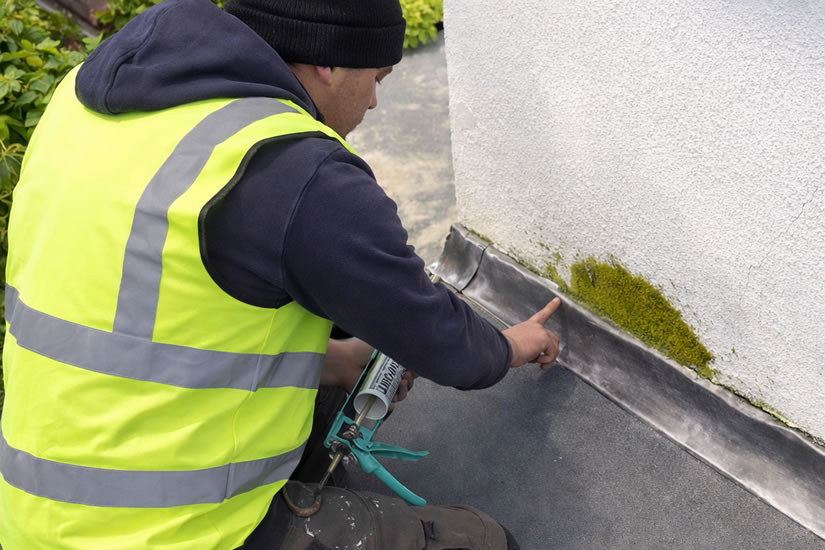
Lead flashing is one of those roofing details you only notice when it fails. When it’s done properly, it quietly keeps water out for years. When it’s bodged (usually with sealant), you get damp patches, mystery leaks in windy rain, and “it’s fine until a storm”.
This guide explains what lead flashing does, how proper repairs are carried out, the common bodges to avoid, and what to ask for in a quote so you get a long-lasting fix.
What is lead flashing?
Lead flashing is a weatherproof strip (or shaped sections) used to seal joints where roof coverings meet walls, chimneys, parapets and abutments.
Common locations you’ll see lead flashing
| Location | Typical roof type | Leak risk if it fails |
|---|---|---|
| Garage roof meets house wall | flat or pitched | very common “mystery leak” |
| Chimney flashing | pitched | common leak point |
| Side wall abutments | pitched | leaks in windy rain |
| Parapet walls | flat | damp patches and tracking water |
Why lead flashing leaks (the common reasons)
Most lead flashing failures come down to movement, age, or poor detailing.
1) Sealant “repairs” that don’t last
A smear of silicone/mastic might hold for a short while, but it often fails because water still tracks behind the flashing or the joint moves.
2) Poor chases or failed pointing
If the flashing is tucked into a mortar joint (chase), cracked/crumbly mortar can let water behind the flashing.
3) Incorrect overlaps and laps
Flashing works by overlap, not glue. If overlaps are too small or badly positioned, wind-driven rain finds a way in.
4) Lead movement (thermal expansion)
Lead expands and contracts. If it’s fixed incorrectly (too rigid, too long without joints), it can crack or pull away.
5) The issue isn’t the lead — it’s the roof edge/junction detail
On attached garages, leaks at the house wall are often a mix of:
- termination detail (flat roof)
- flashing detail
- gutter overflow at the corner
What a proper lead flashing fix looks like
A proper repair is usually one of these: re-secure + re-point, local replacement, or full replacement of the flashing detail.
Proper fix checklist (what you want to see in the quote)
A good flashing repair should include:
- Identifying the real entry point (not guessing)
- Correctly formed lead sections (not random strips)
- Proper laps/overlaps so water sheds outward
- Secure fixing method (without pinning it so tight it can’t move)
- A proper chase detail (if chased into masonry) and tidy pointing
- Correct junction with the roof covering (so water can’t track behind it)
Flat roof junction: what “good” looks like (attached garages)
If your garage has a flat roof meeting a wall, a long-lasting fix usually means:
- the waterproof layer turns up the wall as an upstand
- the top of that upstand is properly terminated
- the lead flashing protects the top edge and sheds water outward
Flat roof wall-junction problems that cause repeat leaks
| Problem | What happens | Proper approach |
|---|---|---|
| Upstand too low | splashback gets behind | increase upstand/detail |
| Termination loose | water tracks behind | secure termination properly |
| Lead added without fixing root cause | leak returns | integrate lead with termination detail |
Pitched roof abutment: what “good” looks like
On pitched roofs, proper leadwork typically uses:
- step flashing (pieces that overlap with each course of tiles)
- cover flashing (covers the top of step flashing)
- correct laps and neat integration into the roof covering
Why step flashing matters
It moves with the tile courses and sheds water naturally. A single long strip slapped against tiles often fails sooner.
The “bodge list”: repairs that usually fail
If you see these in a quote or on your roof, be cautious:
1) “We’ll seal it with silicone”
- Quick, cheap, and often short-lived
- Can trap water and hide the real route of ingress
2) Flashing fixed only at the very top with no proper laps
- Looks tidy, but water can track behind
3) Lead forced tight with too many fixings
- Lead needs to move slightly; over-fixing can cause splitting
4) No mention of the chase/pointing condition
- If the mortar joint is failing, the leak will return
How to tell you need lead flashing repair (common symptoms)
| Symptom | Often points to |
|---|---|
| Leak worse in windy rain | poor overlap or junction gap |
| Damp patch near the wall line | abutment/junction failure |
| Staining down brickwork below flashing | water running behind flashing |
| Leak appears at one corner (especially near gutter corner) | flashing + gutter overflow combination |
| Leak continues briefly after rain stops | water trapped behind detail then releasing |
Typical costs (UK guide)
Costs vary with access, height, and how much leadwork needs replacing.
Flashing repair cost guide
| Job type | Typical range (guide) |
|---|---|
| Small local flashing repair / re-pointing | £150–£350 |
| Replace short section of lead flashing | £250–£600 |
| More involved abutment/flashing works (multiple sections) | £500–£1,200+ |
Tip: If the leak is at the garage-to-house junction, the quote may also include edge/termination detailing or gutter work — that’s often where the real fix is.
What to ask for in your quote (copy/paste)
- Postcode
- Roof type: flat (felt/EPDM/GRP) or pitched (tile/slate)
- “Leak suspected at lead flashing / wall junction”
- When it leaks: heavy rain / windy rain / after rain
- Ask them to specify:
- whether it’s re-point/re-secure or replacement
- how laps/overlaps will be formed
- how the flashing will integrate with the roof covering/termination
- whether gutter overflow could be contributing

FAQs
Can lead flashing be repaired without replacing it?
Often yes. If the lead is generally in good condition, repairs may involve re-securing, re-pointing the chase, and correcting small weak spots. If it’s cracked, badly deformed, or incorrectly installed, replacement is usually better.
Is sealant an acceptable flashing repair?
Sealant can be a very short-term measure in some situations, but it rarely counts as a proper long-term flashing fix. Flashing should shed water by overlap and correct detailing.
Why does flashing leak mainly in windy rain?
Wind pushes rain up and under weak overlaps and gaps. Flashing issues often show up first in wind-driven rain.
Do I always need lead at a garage wall junction?
Not always — it depends on the roof system and detailing. But if the garage roof meets a wall, you do need a robust termination/junction detail. Lead is a common durable option.