

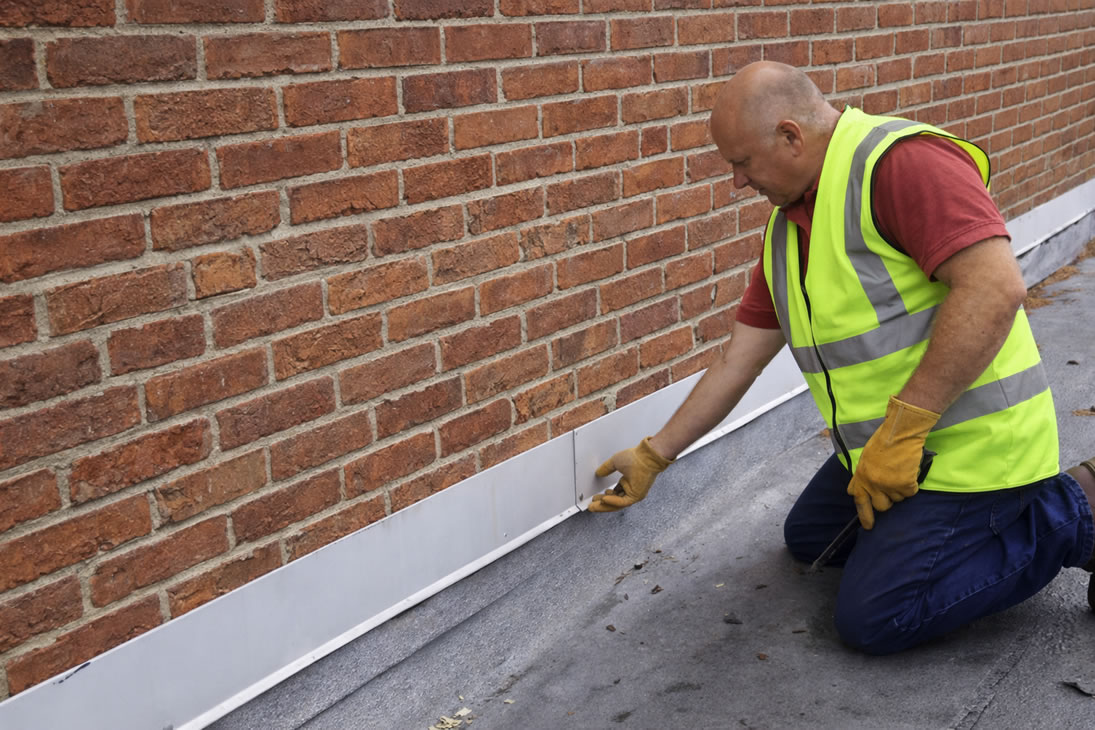
If your garage is attached to your house, the most common “mystery leak” is at the junction where the garage roof meets the house wall. It often shows up as damp patches near the wall, dripping after heavy rain, or leaks that are worse when rain is blowing from a certain direction.
In many cases, the roof covering isn’t the main problem — it’s the flashing and junction detailing (the bits that stop water getting behind the roof at the wall).
This guide explains what flashing is, why it fails, how to spot the signs safely, and what a proper fix usually involves.
Why this junction leaks so often
Rain doesn’t just fall straight down. It:
- runs down the house wall
- gets driven sideways in wind
- bounces off surfaces
- pools at weak points in storms
At the junction, water is trying to get in behind the roof edge. Good detailing forces water back out. Poor detailing gives water a hidden path inside.
What “flashing” actually means (simple explanation)
Flashing is a weatherproof barrier (often metal, but sometimes formed detailing) that protects joints where two building parts meet.
Common flashing/junction parts at an attached garage
| Component | What it does | Where it is |
|---|---|---|
| Abutment flashing | Stops water getting behind roof where it meets wall | Along the house wall |
| Step flashing | Overlaps with courses of brickwork (common on pitched roofs) | On pitched junctions |
| Cover flashing | Protects the top edge of step flashing | Over step flashing |
| Upstand/termination (flat roofs) | Turns the roof covering up the wall and seals it | Flat roof wall junction |
| Chase detail | A cut into mortar/brick to tuck flashing into | On brick walls |
| Seal/pointing | Helps close the joint (not the main waterproofing) | At the top of flashing |
The key point: most “flashing leaks” are not fixed by sealant
A bead of sealant might slow a leak for a short time, but it usually doesn’t address:
- wrong overlap
- poor termination
- water tracking behind the detail
- movement and cracking in the joint
A proper fix relies on layers and overlaps, not just “sticking it”.
7 common flashing failure causes (and how they leak)
1) Flashing pulling away from the wall
What happens
Over time, fixings loosen or the wall joint cracks, creating a gap where water runs behind the flashing.
Clues
- visible gap along the wall line
- damp patch inside near the wall
- leak worse in windy rain
Typical fix
Re-secure and re-detail flashing properly (not just seal the gap).
2) Failed or cracked pointing at the top edge
What happens
If the top edge of the flashing is tucked into mortar, the pointing can crack, allowing water behind it.
Clues
- crumbly mortar line above flashing
- staining on brickwork under the flashing
Typical fix
Re-pointing/re-sealing the chase detail as part of the flashing repair.
3) Flat roof termination detail is weak (EPDM/felt/GRP)
On flat roofs, the most important part is how the waterproof layer ends at the wall.
Common mistakes
- roof covering stops short or isn’t turned up the wall
- termination bar is loose
- adhesive or surface prep was poor
- no proper upstand height, so splashback gets in
Typical fix
Rebuild the termination detail with correct upstand and secure termination.
4) Water tracking behind cladding or render at the junction
Sometimes the roof junction is hidden behind:
- render
- cladding
- a poorly sealed strip
Water can enter behind the finish and then appear inside the garage as a “roof leak”.
Typical fix
Open up and correctly detail the junction so water can’t track behind finishes.
5) Poor overlap or wrong flashing type for the roof
Flashing needs correct overlap and shape. On pitched roofs, step flashing and cover flashing need to work with the tile courses. On flat roofs, the upstand and termination must suit the system.
Clues
- leaks only when rain hits from one direction
- leak appears to “move” slightly inside (water tracks)
Typical fix
Correct flashing type and overlap for the roof design.
6) Gutters overflowing near the junction
This one catches people out: overflowing gutters at the house/garage corner can soak the wall and make it look like the roof junction is failing.
Clues
- overflow during heavy rain
- damp streaks down the wall
- leak appears near the corner
Typical fix
Fix the gutter flow first, then address any remaining junction issues.
7) Movement cracks at the junction (especially older garages)
Garages and houses can move slightly differently over time. Small movement can crack mortar joints and open tiny gaps.
Typical fix
A properly detailed flashing solution that tolerates movement, rather than relying purely on rigid mortar.
How to tell it’s a junction/flashing leak (common patterns)
| Pattern | Suggests |
|---|---|
| Leak is close to the house wall line | wall junction issue |
| Worse in windy rain | flashing overlap/termination weakness |
| Leak appears at the corner where gutter meets wall | gutter overflow + junction |
| Leak continues briefly after rain stops | water trapped behind detail then releasing |
What a proper repair usually includes
When a roofer quotes for this, you want them to mention:
Flat roof attached garage (common)
- check and rebuild the upstand
- secure termination properly
- correct trims and sealing at the wall line
- check drainage so water isn’t pooling at junction
Pitched roof attached garage
- replace/repair step flashing
- add cover flashing as needed
- ensure correct chase detail and pointing
- check tiles/underlay near the junction
Tip: If your quote just says “seal flashing”, ask for more detail. A long-term fix should describe the overlap/termination method.

What to include in your quote request (copy/paste)
- Postcode
- Garage type: attached to house (yes)
- Roof type: flat felt / EPDM / GRP / pitched tiles
- “Leak occurs at the wall junction where garage meets house”
- When it leaks: heavy rain / windy rain / after rain
- Photos from ground level showing the junction line and gutter corner
- Ask: “Please specify how the flashing/termination detail will be repaired”
FAQs
Why does it leak more when it’s windy?
Wind-driven rain gets pushed under weak overlaps and behind poor termination details. Junction leaks often show up mainly in windy rain.
Can I just seal the flashing with silicone?
Sometimes it helps briefly, but it rarely fixes the real cause long-term. Proper flashing relies on correct overlap and termination, not just sealant.
How do I know it’s not just the gutter overflowing?
Check during heavy rain: if water is spilling at the corner or down the wall, gutter overflow can mimic a roof junction leak. Often both issues need attention.
Is this a repair or replacement job?
Usually a repair, if the roof covering is otherwise sound. If the roof is old and failing in multiple places, replacement may be better value while fixing the junction properly.

