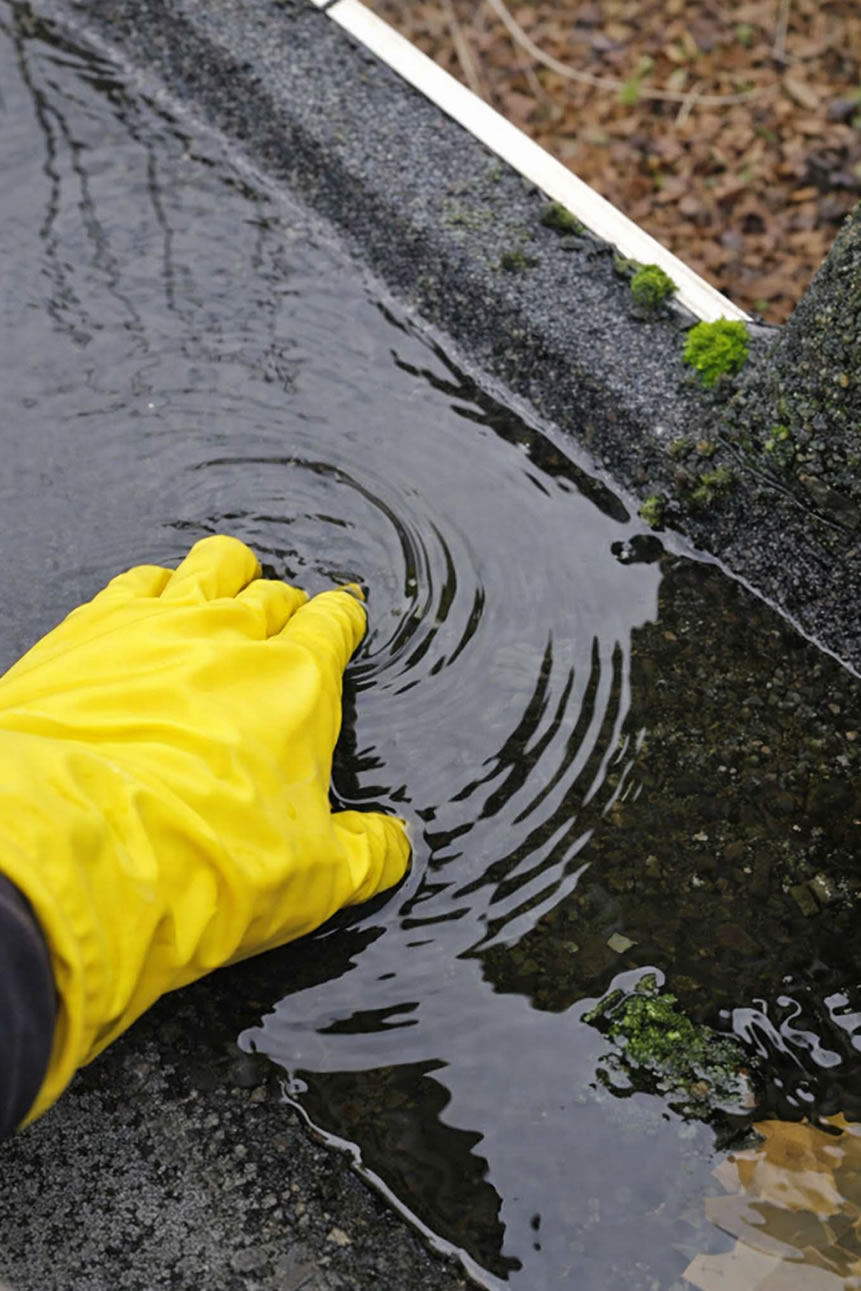
If you’ve noticed puddles sitting on your garage roof after rain, that’s called ponding water. It’s common on older flat garage roofs, but it’s also one of the biggest reasons roofs start leaking (or keep leaking even after repairs).
The short answer: a little water that disappears quickly isn’t always a big issue, but standing water that hangs around can shorten the life of your roof and make leaks far more likely.
This guide explains what ponding means, when it becomes a problem, what causes it, and what fixes actually work in the UK.
What is “ponding water”?
Ponding water is simply water that sits on a flat roof instead of draining away. Some flat roofs will hold a small amount of water briefly after a downpour, but ideally it should clear as the water runs to a gutter or outlet.
Quick definition table
| Term | Meaning |
|---|---|
| Ponding | Water collects in low spots and stays there |
| Positive fall | The roof is built so water naturally drains away |
| Outlet/drain | The point where water leaves the roof (gutter, hopper, pipe) |
Is ponding water always a problem?
Not always — but it depends on how much water and how long it stays.
When it’s usually NOT a big issue
- Small shallow puddles after a storm
- Water clears within a reasonable time (often within a day, depending on weather)
- No signs of leaks, blisters, or damp inside the garage
When it IS a problem
- Water sits in the same place after most rain
- The puddle is deep enough to cover seams/joins for long periods
- You have leaks that continue after rain stops
- The felt looks blistered, cracked, or seams are lifting
- You can see sagging from inside the garage (decking/timbers may be soft)
Why ponding water causes leaks (and roof failure)
Ponding water puts your roof under constant stress:
1) It finds weak seams and edges
Most flat roof leaks aren’t in the middle — they’re at seams, corners, and edges. Standing water gives it time to work its way into tiny gaps.
2) It accelerates felt problems
On felt roofs, ponding increases the chance of:
- seam failure
- blisters/bubbles (especially if moisture gets trapped)
- splits appearing at weak points
3) It can reveal (or create) deck problems
If the roof deck has softened over time, it can sag slightly, creating a low spot that holds more water — which then worsens the sagging. It’s a cycle.
Common causes of ponding on garage roofs
Ponding usually comes from one of these issues:
1) Poor roof falls (flat roofs still need a “fall”)
If the roof was built too flat, or the falls were never correct, water won’t drain.
2) Settling and movement over time
Garages settle. Deck boards sag. Old timbers relax. Low spots form.
3) Blocked outlets, gutters or downpipes
A roof can have a decent fall, but if the outlet is blocked, water still pools.
4) Edges and trims holding water back
Sometimes the drip edge detail or trim creates a tiny “dam” that prevents water escaping.
How to tell if it’s ponding or just “wet after rain”
Here’s a simple homeowner check (no roof walking needed):
Safe checks you can do
- Look at the roof from a window or ladder position (safely) after rain
- Note where the water sits and how big the puddle is
- Check again later: does it drain away or remain?
- Inside the garage: look for damp lines on the ceiling near the low spot area
Pattern clue table
| What you notice | Suggests |
|---|---|
| Water always sits in the same spot | low point in deck / poor fall |
| Water sits near the outlet area | outlet blocked or detail failing |
| Leak continues after rain stops | ponding stressing seams |
| Blisters in felt near puddle area | trapped moisture + heat expansion |

Should you repair ponding water or replace the roof?
This depends on whether the roof covering is still in good condition.
Repair might be enough when:
- the roof covering is otherwise sound
- ponding is mild and drainage can be improved
- the leak is at a specific seam/outlet detail
- there’s no soft deck/sagging
Replacement is more likely when:
- felt is cracking/blistering widely
- ponding is significant and constant
- the roof deck has sagged/softened
- you’ve already patched leaks and they return
What fixes actually work (and what doesn’t)
Fixes that often work
| Fix option | Best for | What it involves |
|---|---|---|
| Clear/repair gutters and outlets | outlet/drainage blockage | cleaning, replacing outlet, improving flow |
| Edge detail repair | water tracking under edge | proper drip detail, trims, sealing in system |
| Localised deck repair | small sag/low spot | lifting covering, repairing deck, re-covering |
| Re-roof with corrected falls | persistent ponding | rebuild/reform falls so water drains properly |
Fixes that usually DON’T solve ponding long-term
- “Painting” the roof with sealant
- Endless patching over the same low spot
- Ignoring gutters/outlets while patching the surface
If the roof design or deck has created a low point, you need to address the cause, not just the symptom.
How ponding affects cost (what to expect in quotes)
Ponding often changes a quote because roofers may recommend:
- correcting falls
- replacing sections of decking
- improving drainage outlets
- re-detailing edges and junctions
This can push a job from a simple patch repair into a more permanent solution — but it usually saves money long-term compared with repeated call-outs.
What to include in your quote request (copy/paste)
- Postcode
- Garage size (single/double or rough length × width)
- Roof type (felt / EPDM / GRP)
- “Ponding water in the middle/front/back (describe location)”
- How long water stays after rain
- Any leaks continuing after rain stops
- Photos from safe viewpoints (window/ground level)
- Ask: “Can you advise on correcting falls and drainage?”
FAQs
Is ponding water on a flat garage roof normal?
A small amount of water briefly after heavy rain can happen, but standing water that stays in the same place regularly is a warning sign.
Can ponding water cause a roof leak?
Yes. Ponding stresses seams and edges and gives water time to work into weak points. It also worsens felt ageing and can expose deck sagging.
Will a simple patch fix ponding?
A patch may stop a leak temporarily, but it usually won’t fix ponding. If water keeps sitting there, the problem often returns unless drainage or falls are improved.
Does EPDM handle ponding better than felt?
EPDM is durable, but ponding still isn’t ideal because weak edges, terminations and outlets can fail if water is constantly sitting there. Drainage still matters.