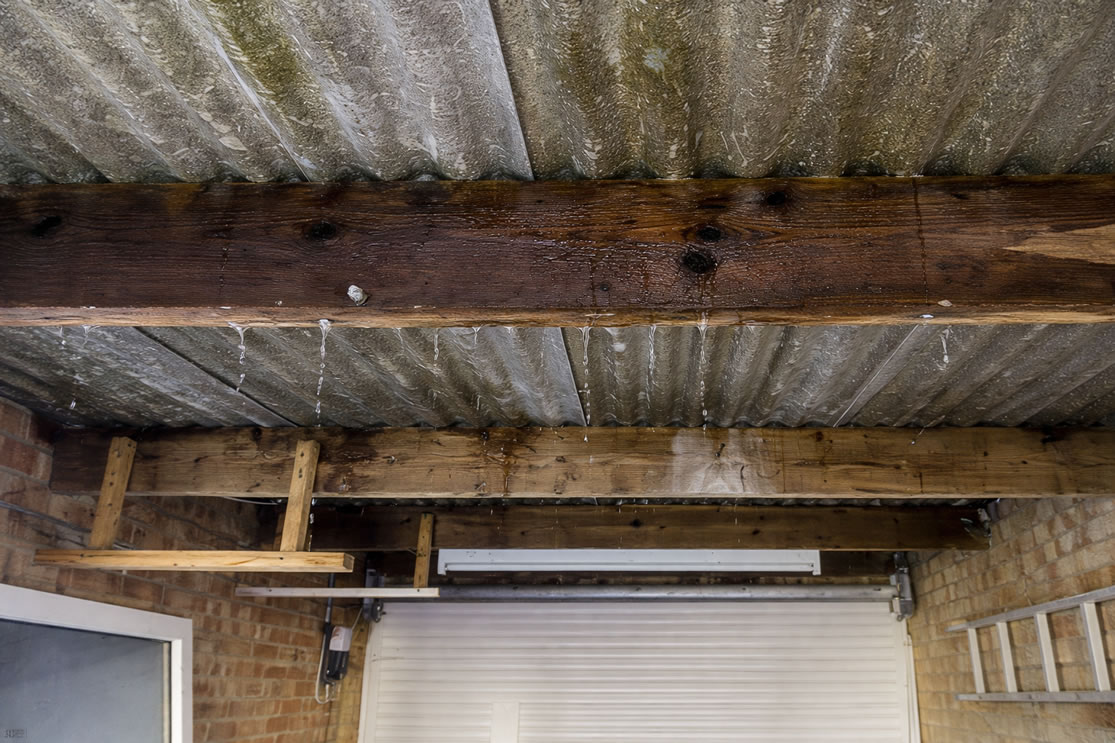
A leaking garage roof is one of those problems that starts small, then suddenly becomes a bigger mess: damp patches, dripping onto tools, mouldy smells, and timber that slowly softens. The good news is that most garage roof leaks come from a few predictable weak points — and if you act quickly, you can often reduce damage while you arrange a proper repair.
This guide walks you through what to do step by step, what you can safely check yourself, and what to include when requesting quotes in the UK.
Step 1: Make it safe and stop the damage spreading
Before you do anything else, focus on safety and damage control.
If water is dripping inside the garage
- Move valuables away from the leak area (tools, electrics, cardboard boxes).
- Put down a bucket/tray and lay old towels around it to catch splashes.
- If water is near lights, sockets, garage door motors, or extension leads, turn off power to the garage circuit if you can do so safely.
- Ventilate the space if possible (crack the door open) to reduce condensation and damp.
Quick “damage control” checklist
| Action | Why it matters | DIY-safe? |
|---|---|---|
| Catch drips with bucket/tray | Prevents puddles and damage | Yes |
| Move items away from leak | Protects belongings | Yes |
| Switch off electrics if water is near wiring | Reduces risk | Yes (if safe) |
| Ventilate garage | Helps dry out | Yes |
| Avoid climbing on roof | Prevents falls and roof breakage | Yes |
Step 2: Identify what type of garage roof you have (it changes the likely cause)
You don’t need to be a roofer — just work out the basic type from ground level.
| Roof type | Common on | What leaks usually relate to |
|---|---|---|
| Flat felt roof | Many older UK garages | splits, blistering, edge lifts, joints |
| EPDM rubber roof | Newer flat roof upgrades | edges, terminations, punctures, outlets |
| GRP fibreglass roof | Some upgraded garages | cracks at trims/joins, poor detailing |
| Corrugated sheets (metal/bitumen/cement) | Detached/outbuildings | fixings, overlaps, edge detailing |
| Pitched tiled/slate roof | Some garages/coach houses | slipped tiles, ridge issues, flashing, gutters |
Tip: If the roof is corrugated cement sheets and the garage is older, treat it cautiously — you may need advice because some older cement sheets can contain asbestos.
Step 3: Work out when it leaks (this is your best clue)
Leaks behave differently depending on the cause.
“Leak timing” guide
| When the leak happens | Often points to | Why |
|---|---|---|
| Only in heavy rain | overflow, blocked gutters/outlets, weak joints | water volume overwhelms weak points |
| Mainly in windy rain | edge/junction/flashing issue | wind drives rain under edges/overlaps |
| Even after rain stops | ponding water on flat roof | water sits and finds seams |
| Only during storms | loose sheets/tiles, damaged fixings | movement opens gaps |
| No rain, but droplets | condensation | warm air meets cold roof surface |
Step 4: Do a safe outside check (from ground level only)
You’re not trying to “fix” it here — you’re gathering clues so your quote is accurate.
Look for these common leak sources
- Gutters overflowing: water pouring over the front edge can look like a roof leak.
- Downpipe blockages: water backing up can spill at the outlet.
- Flat roof edges lifting: felt lifting at the drip edge or corners is a classic leak start.
- Wall junction (attached garages): leaks where the garage roof meets the house wall are extremely common.
- Corrugated sheet fixings: leaks often happen at screw heads/washers or overlaps.
- Pitched roof tiles: slipped/cracked tiles can leak only in certain wind directions.
Quick “likely cause” table (most common)
| What you see | Likely cause | Typical next step |
|---|---|---|
| Water staining near front edge | gutter overflow or edge detail leak | clear/repair guttering, check drip edge |
| Leak near wall where garage meets house | flashing/junction detail failing | flashing repair / termination detail |
| Drips along a line inside | seam/joint issue on flat roof | repair seam or replace section |
| Drips near a screw line on corrugated roof | failed washers/fixings | replace fixings or sheets if widespread |
| Soft/sagging area | decking/timber damage underneath | inspection + possible deck repair |
| Only winter mornings, no rain | condensation | improve ventilation / insulation strategy |
Step 5: Use a temporary emergency measure (only if it’s safe and you can reach without climbing)
If you can’t get a roofer immediately, a temporary cover can reduce damage.
Temporary options (short-term only)
| Temporary measure | Where it helps | What to avoid |
|---|---|---|
| Plastic sheeting/tarpaulin weighed down | broad drip area | don’t nail into suspected asbestos/cement sheets |
| Bucket/tray + absorbent towels | internal drips | don’t ignore electrics nearby |
| Redirect overflow from gutter | obvious gutter spill | don’t climb ladders in high wind |
| Clear visible gutter blockages (from safe access) | overflow problems | don’t overreach; avoid risky ladder use |
Important: Temporary fixes aren’t a substitute for repair — they just buy time.
Step 6: Decide if it’s a repair job or a replacement job
Most homeowners want a straight answer: “can this be repaired?” Here’s a practical way to think about it.
Repair vs replacement decision table
| Scenario | Often best as… | Why |
|---|---|---|
| One leak point, roof otherwise sound | Repair | targeted fix can last |
| Edges/junctions failing but roof surface OK | Repair + detailing | most leaks are at details |
| Multiple leaks + repeated patches | Replacement | patches keep chasing problems |
| Felt brittle, cracking, blistering widely | Replacement | covering is failing overall |
| Soft deck / sagging areas | Depends | deck repair may be needed either way |
| Corrugated sheets cracked/rusted widely | Replacement | fixings/overlaps failing everywhere |
Step 7: What to include in your quote request (copy/paste)
The more precise your info, the more accurate your quotes will be.
Copy/paste template:
- Postcode
- Garage type: single/double (or rough size)
- Roof type: flat felt / EPDM / GRP / corrugated / pitched (or “not sure”)
- Leak location: front edge / near house wall / centre / corner / near door
- Leak timing: heavy rain / windy rain / after rain / storms / no rain (condensation)
- What you’ve noticed: lifting edges, ponding water, overflow gutters, cracked sheets, slipped tiles
- Access notes: tight driveway, attached garage, height/obstructions
- If urgent: write “urgent leak”

Common leak causes by roof type (quick reference)
Flat felt garage roof
- splits/cracks in felt
- lifted edges and corners
- failed joints/seams
- ponding water stressing seams
- worn outlets/drip edges
EPDM rubber roof
- poor edge detail / loose perimeter trims
- weak termination at wall junctions
- punctures from sharp debris
- outlet detail issues
GRP fibreglass roof
- cracks at trims or corners
- poor join detailing
- topcoat breakdown near edges
Corrugated sheet roof (metal/bitumen/cement)
- failed washers on fixings
- overlaps letting in wind-driven rain
- sheets lifted in storms
- rust holes (metal)
Pitched garage roof
- slipped/cracked tiles
- ridge tile issues
- flashing problems (especially at walls)
- guttering overflow
When to act fast
Get quotes urgently if you see:
- active dripping onto electrics
- a sagging roof section
- cracks/breaks in corrugated sheets with debris falling
- damp spreading quickly across the ceiling/rafters
- mould smell developing (a sign damp has been there a while)
FAQs
Can a leaking garage roof be repaired without replacing the whole roof?
Often yes, if the leak is localised and the rest of the roof covering is in good condition. If the roof is brittle, cracked widely, or has multiple leak points, replacement is usually more reliable.
Why does it only leak when it’s windy?
Wind-driven rain gets pushed under weak edges, overlaps, and flashing/junction details. That’s why attached garages often leak where the roof meets the house wall.
My garage roof is leaking but the gutters are overflowing — which is it?
Overflowing gutters can mimic a roof leak because water runs back under the edge or straight down the wall. It’s common to fix both: clear/repair gutters and address any edge detail issues.
What if the leak is actually condensation?
Condensation often shows up as droplets on cold mornings, even when it hasn’t rained. Better ventilation and keeping the garage less “moist” inside usually helps.
Is a leaking garage roof an emergency?
It can be if water is near electrics, the roof is sagging, or it’s damaging stored items. Otherwise, it’s still worth acting quickly to avoid timber damage and mould.